
"You see, I have been in Commerce for the last seven years and I am perhaps the only factor that provides continuity in this ministry," Khullar says with unconcealed pride.

Wholesale inflation in the country rose for the fourth consecutive month in June at 3.36 per cent on account of rise in prices of food articles, especially vegetables and manufactured items. The wholesale price index (WPI) based inflation was 2.61 per cent in May. It was (-) 4.18 per cent in June 2023.

Eying benefits from digital banking, lenders are now looking at building Unified Recovery Interface (URI) for enhancing efficiency, reducing costs, and getting good prices for properties of defaulters. This would be managed by PSB Alliance Ltd, a company set up by all public sector banks in the country. M V Rao, chairman, Indian Banks' Association (IBA), said: "Till now we had Unified Payments Interface (UPI), a product developed by National Payments Corporation Ltd (NPCI).

Link your UPI app to a separate bank account or wallet that has only a limited sum.
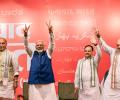
While there are some new faces in the cabinet, leaders such as BJP president JP Nadda and Jual Oram have returned as ministers.

India has reduced the time period for foreign investors to seek international arbitration from five years to three years as part of the recently signed investment pact with the United Arab Emirates (UAE), a departure from its model Bilateral Investment Treaty (BIT). Under the Investor-State Dispute Settlement (ISDS) mechanism, if the Indian judicial system is unable to resolve a dispute within this shortened period, investors can resort to international arbitration. The investment pact, signed on February 13 in Abu Dhabi, came into force on August 31, replacing the previous pact.

As the Union government explores ways to restrict import of laptops and other electronic devices starting with a 5 per cent reduction from the current level, it is working to ensure that there's no supply disruption in India even if an import cap is introduced, it is learnt. The caveat assumes significance in the context of the government's announcement of its plan in August 2023 to issue licences for import of select IT hardware products to reduce the country's dependence on China.

Foreign Secretary Vikram Misri arrived in Dhaka on Monday on a day-long visit to hold talks with his Bangladeshi counterpart, amid strained bilateral ties since August following the ouster of prime minister Sheikh Hasina.

Securities regulator Guo Shuqing is tipped to take the helm at the $482 billion state investment vehicle, China Investment Corp, and China's chief trade representative, Gao Hucheng, is seen running the Commerce Ministry, two sources with leadership ties told Reuters.

Bharatiya Janata Party's National Democratic Alliance partners have got five cabinet ministerial berths in the third term of Prime Minister Narendra Modi, as against none in the outgoing government, given the party's dependence on allies for a majority in the Lok Sabha.

Three years and Rs 28,710 crore worth of transactions later, it has more than double the number of sellers than Flipkart.

Following the disengagement, both sides will soon start the coordinated patrolling in their respective areas, sources added.

India recorded the highest monthly exports during the fiscal in February, registering an 11.9 per cent growth to $41.4 billion, mainly driven by increased shipments of engineering goods, electronic items and pharma products. The trade deficit during February worked out to $18.7 billion, up from $16.57 billion in the year-ago month, as gold imports surged significantly. Merchandise imports were valued at $60.11 billion, up 12.16 per cent compared to $53.58 per cent in February 2023.

The Modi government's flagship initiative 'Make in India' launched 10 years ago has helped the country boost exports, push investments and promote manufacturing. Under the initiative, launched on September 25, 2014, a series of measures have been taken by the government to boost local manufacturing. These initiatives include the rollout of production linked incentive (PLI) schemes for 14 sectors, easing foreign direct investment (FDI) norms, reducing compliance burden to improve business climate, all approvals through single window, and rolling out of the national logistics policy.
India's merchandise exports in April 2024 marginally rose to $34.99 billion from $34.62 billion in the year-ago month, according to government data released on Wednesday. Imports too increased to $54.09 billion from $49.06 billion in April 2023.

The wholesale inflation rose for the third consecutive month in May at 2.61 per cent on account of rise in prices of food articles, especially vegetables, and manufactured items. The wholesale price index (WPI) based inflation was 1.26 per cent in the previous month. It was (-) 3.61 per cent in May 2023. "Positive rate of inflation in May, 2024 is primarily due to increase in prices of food articles, manufacture of food products, crude petroleum & natural gas, mineral oils, other manufacturing etc," the ministry of commerce & industry said in a statement on Friday.

The revamped Special Economic Zone (SEZ) law is unlikely to see the light of the day before the upcoming Lok Sabha elections, two people aware of the matter said. The commerce department had sought the Union Cabinet's nod to bring amendments to the existing SEZ Act, 2005 late last year. The plan, thereafter, was to introduce the Bill in the winter session of Parliament. Cabinet's approval remains pending.
Concerned over the fallout of the Red Sea crisis and severe shortage of containers against the backdrop of a steep decline in merchandise exports in August, the Union government is pulling out all the stops to find a solution. To begin with, the government has devised a strategy aimed at boosting container supply and supporting exporters.

The strong message from the prime minister is of continuity of policies he considers right with strong emphasis on execution, points out T N C Rajagopalan.

India stares at the risk of an influx of Chinese products as US tariffs on a range of Chinese goods, including solar panels, electric vehicles, lithium-ion batteries, syringes, and steel, are set to take effect from September 27. With higher tariffs reducing China's access to the US market, there is concern that China may divert its exports to other markets, including India, which could lead to potential dumping of goods. This situation could challenge Indian industries, particularly in sectors where competition with Chinese products is already fierce.

The biggest fear many of the e-commerce firms have is the possible requirement to change business models overnight, which would drastically increase costs as well as disrupt businesses.

Wholesale inflation fell to a 4-month low of 1.31 per cent in August due to a decline in prices of vegetables and fuel, even though onion and potato prices spiked, according to official data released on Tuesday. Wholesale price index-based inflation fell for the second straight month in August after it hit a high of 3.43 per cent in May. Inflation in July was 2.04 per cent. In August last year, WPI inflation was (-) 0.46 per cent.

Among other things, taking note of complaints against several Chinese e-commerce players such as Shein, Ali Express etc for sending shipments as 'gifts' to customers in India and avoiding duties, the government has now mandated that all e-commerce sites and apps must have a registered business entity. This will be the importer on record and subject to customs rules, report Subhayan Chakraborty, Neha Alawadhi and Karan Choudhury.

Despite the slowdown in world economies, the government expects exports to increase 20 percent in the current fiscal, a senior commerce ministry official said here on Friday.

The two countries also signed a 'Memorandum of Agreement regarding the Assignment of Liaison Officers', which will facilitate the posting of one military officer from each country with the military of the other.
Yojana Bhawan is working overtime to complete the crucial Approach paper to the 12th Plan amidst a buzz that Planning Commission Deputy Chairman Montek Singh Ahluwalia may get a Cabinet berth in the reshuffle expected soon.

This is the Tesla CEO's first visit to China in three years.

From the rollback of customs duty on key electronic components to fast tracking delivery of goods imported from China, players are looking for incentives on several counts.

Amidst strained ties with China, the pre-budget Economic Survey on Monday made a strong case for seeking foreign direct investments (FDI) from Beijing to boost local manufacturing and tap the export market. As the US and Europe are shifting their immediate sourcing away from China, it is more effective to have Chinese companies invest in India and then export the products to these markets rather than importing from the neighbouring country, the Survey said.

'They were ahead of their times. We don't expect this from a civilisation of the first century AD.'

'The race is now on for Indian IT firms to develop their AI prowess and focus on a software-first approach to services as the people element becomes more complicated with Trump's expected new regulations.'

Eyeing $9 billion business opportunity in booming e-commerce business, India Post, which has the biggest network and serves the last mile, is boosting its infrastructure for real-time tracking of parcels through satellites using a new technology.

'It is unclear whether clothing or home items qualify as essential items. A lot of professionals are working from home, and they need electronics for their productivity. Does this qualify as essential?'

Minister of state for personnel Jitendra Singh said it is a major step to place the right talent for the right role.

Glimpses from the Bharat Mobility Global Expo in New Delhi.

The government is planning to tweak its procurement policy to give a fillip to domestic manufacturing. The industry department has floated a proposal to raise the minimum local content requirement for public procurement for Class-I and -II suppliers from 50 per cent currently to 70 per cent, and 20 per cent as of now to 50 per cent, respectively.

India's merchandise exports rose by 9.1 per cent to $38.13 billion in May even as the trade deficit widened to a seven-month high of $23.78 billion during the month, according to government data. Healthy growth in sectors, such as engineering, electronics, pharmaceuticals, textiles and plastics helped register growth in exports despite global economic uncertainties.

The wholesale inflation rose to a 13-month high of 1.26 per cent in April fuelled by rising prices of food articles, especially vegetables, amid expectations of RBI holding interest rates in the policy review next month. The wholesale price index (WPI) based inflation has been rising for two months in a row.
